By Henry Caldwell
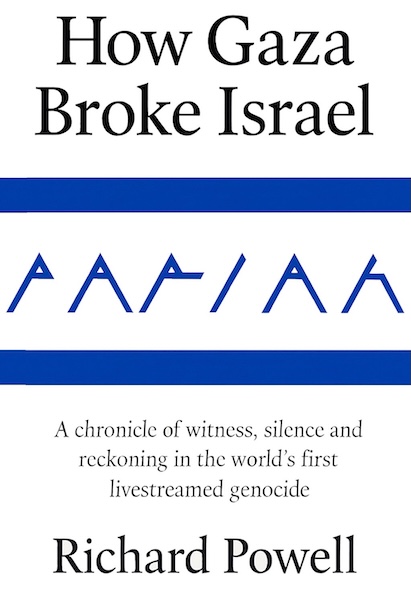
Some wars are absorbed into history as chapters. Others become defining moral markers. Richard Powell’s Pariah: How Gaza Broke Israel argues that the Gaza war may belong to the latter category. The book is not only an account of destruction or diplomacy. It is an argument about how collective memory forms in the digital age.
Powell begins with a proposition: visibility changes history. In earlier conflicts, documentation often emerged gradually through investigative journalism, declassified archives or post-war tribunals. In Gaza, video evidence circulated in real time. The archive formed alongside the event.
This immediacy altered the relationship between power and narrative. Civilian footage, hospital testimonies and satellite imagery created a durable digital record. Powell argues that such evidence resists later revision more effectively than traditional reportage.
The book situates this transformation within the longer history of the Israel–Palestine conflict. The blockade of Gaza, cycles of escalation and unresolved sovereignty disputes form the structural backdrop. By contextualising the war within decades of tension, Powell emphasises that historical memory cannot isolate October 2023 from prior policy.
Generational politics features prominently in this final section. Powell notes that younger audiences, particularly in Western democracies, consumed the Gaza war primarily through social media platforms rather than legacy news outlets. This shift, he argues, influences long-term political consciousness.
The language of legitimacy recurs throughout the book. Powell contends that military power does not automatically translate into moral authority. When devastation is documented continuously, reputational consequences endure beyond tactical success.
Legal proceedings reinforce memory formation. Filings at the International Court of Justice and investigations by the International Criminal Court embed the conflict within institutional archives. Even absent final verdicts, such proceedings shape how future historians interpret events.
The book also addresses the politics of casualty counting. Powell argues that narrow statistical definitions risk minimising the cumulative impact of siege conditions. How deaths are categorised influences how they are remembered.
Media ecosystems amplify this process. Headlines, viral videos and algorithmic amplification all contribute to what becomes part of the collective narrative. Powell suggests that Gaza demonstrated how digital platforms accelerate the formation of moral consensus — or division.
The prose in these chapters is reflective rather than accusatory. Powell steps back from immediate policy debates to consider how historical turning points are recognised. He draws parallels with previous conflicts where public perception shifted gradually before crystallising.
Critics may argue that historical memory is unpredictable and often contested. Powell acknowledges this uncertainty. His claim is not that Gaza’s legacy is fixed, but that the informational conditions surrounding it make erasure unlikely.
As a work of contemporary political writing, Pariah closes on a forward-looking note. The war’s diplomatic consequences may evolve, alliances may stabilise, legal proceedings may stall or advance. What will persist, Powell suggests, is the archive.
In an era of permanent documentation, the rubble of Gaza exists not only in physical space but in digital memory. That memory will inform future debates about international law, accountability and state power.
Whether Gaza ultimately redefines the Israel–Palestine conflict remains uncertain. But Powell’s central insight is compelling: some wars are remembered not because they ended, but because they were seen.
Pariah: How Gaza Broke Israel can be purchased in ebook, paperback and hardback formats. Full retailer information, including Amazon links, is available at https://pariahbook.com/, which also provides free access to the opening three chapters.