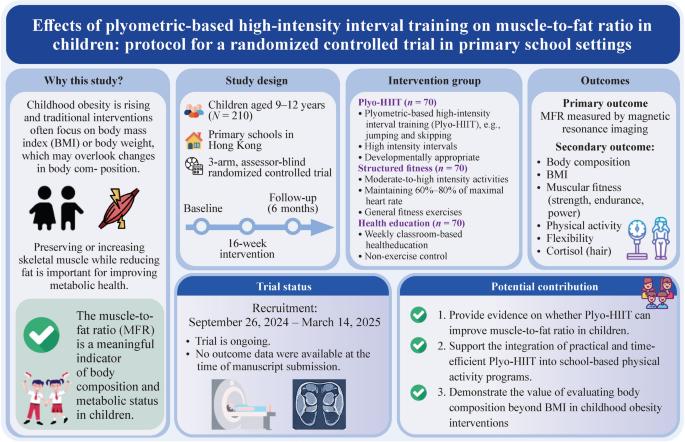
KNOXVILLE, TN, August 29, 2026 /24-7PressRelease/ — Researchers are testing whether a school-based exercise program—combining plyometric jumping drills with high-intensity interval training (HIIT)—can improve the muscle-to-fat ratio (MFR) in children aged 9 to 12. Unlike conventional weight-loss approaches that often sacrifice muscle along with fat, this intervention is designed to preserve metabolically active skeletal muscle while reducing adiposity. If the hypothesis holds, the findings could push pediatric obesity evaluation beyond body mass index (BMI) toward a more meaningful metric of metabolic health.
Traditional weight-loss strategies for children, from calorie restriction to general aerobic exercise, often carry an unwanted side effect: they cut fat, but they also erode muscle mass. That matters because skeletal muscle is not merely about strength—it is a metabolic engine that regulates glucose uptake, stores amino acids, and accounts for roughly 20% to 30% of resting energy expenditure. Losing muscle can lower metabolic rate, impair physical function, and raise the odds of weight regain. Meanwhile, body mass index (BMI), the most common measure in obesity research, cannot distinguish fat from lean tissue, masking these critical shifts. Based on these challenges, there is an urgent need for in-depth research into interventions that can reduce fat while preserving or even enhancing muscle in children.
Now, researchers from Hong Kong Baptist University have designed a pragmatic, assessor-blinded, three-arm randomized controlled trial (RCT) to address this gap. The study, published (DOI: 10.1007/s12519-026-01064-z) on July 18, 2026, in the World Journal of Pediatrics, has enrolled 210 children aged 9–12 from local primary schools. Participants were randomly assigned to a 16-week plyometric-based high-intensity interval training (Plyo-HIIT) program, a structured fitness (SF) program, or a health education (HE) control group.
The Plyo-HIIT program is built for real-world school settings. Each 45-minute session includes a warm-up, a main phase with four 2-minute rope-skipping intervals followed by structured plyometric circuits, and a cool-down. Exercises progress across four phases: double-leg jumps and medicine ball dips in weeks 1–4; hurdle hops and zigzag drills in weeks 5–8; split squat jumps and tuck jumps in weeks 9–12; and single-leg cone hops with caterpillar walks in weeks 13–16. To ensure safety, jump contacts are gradually increased from about 50 to roughly 80 per session, managing mechanical loading while prioritizing movement quality and controlled landings over maximal performance. Strict eligibility criteria were applied—children with congenital heart disease, recent musculoskeletal injuries, or other underlying conditions were excluded. All sessions are supervised by trained instructors who can adjust repetitions and rest intervals based on individual tolerance, and the protocol received institutional ethics approval with written parental consent obtained prior to enrollment.
“The problem with many childhood obesity interventions is that they focus on weight rather than what that weight is made of,” the authors said. “When you lose fat alongside muscle, you’re not just losing strength—you’re losing metabolic protection. We designed Plyo-HIIT to be practical for schools, using nothing more than body weight and a bit of space. If this works, it gives schools a time-efficient, equipment-free strategy. But the real question isn’t just whether kids lose weight—it’s whether they’re building a healthier body composition for the long run.”
The implications, should the trial yield positive results, extend well beyond the classroom. A proven Plyo-HIIT program could be integrated into after-school activities and physical education curricula at minimal cost, aligning with World Health Organization (WHO) recommendations for daily moderate-to-vigorous activity. Its equipment-free design makes it scalable in both high-income and resource-limited settings. More importantly, by using magnetic resonance imaging (MRI)-derived muscle-to-fat ratio (MFR) as the primary endpoint, the study could reshape how success is defined in pediatric obesity research—prioritizing metabolic health over simple weight reduction. However, any future implementation of such high-intensity jumping programs should incorporate pre-participation health screening and structured, supervised progression, as carefully done in this trial, to minimize injury risk.
References
DOI
10.1007/s12519-026-01064-z
Original Source URL
https://doi.org/10.1007/s12519-026-01064-z
Funding Information
Initiation Grant for Faculty Niche Research Area of Hong Kong Baptist University (grant No. 160300) and Tier 1 Research Start-up Grants (grant No. 162894).
About World Journal of Pediatrics
World Journal of Pediatrics (WJP) is an international, peer-reviewed academic journal dedicated to advancing pediatric medicine and child health. Published monthly, WJP publishes original research, reviews, and special reports covering all aspects of pediatrics. It welcomes contributions from pediatricians and researchers worldwide, focusing on the latest developments in pediatric clinical practice, pediatric surgery, preventive child healthcare, pharmacology, stomatology, and biomedicine, as well as basic and experimental sciences. The journal provides a global platform for academic exchange and dissemination of medical research findings. WJP currently has an Impact Factor of 7.3 and a CiteScore of 8.5.
Chuanlink Innovations, where revolutionary ideas meet their true potential. Our name, rooted in the essence of transmission and connection, reflects our commitment to fostering innovation and facilitating the journey of ideas from inception to realization.
Related Link:
http://chuanlink-innovations.com
—
For the original version of this press release, please visit 24-7PressRelease.com here
Legal Disclaimer: The content on this page is syndicated from independent third-party providers. Kyrion Media makes no warranties or representations regarding the accuracy, completeness, legality, or reliability of the information, including text, images, videos, or licenses. If you are affiliated with this content or have any complaints, copyright concerns, or requests for removal, please contact us at [email protected] with the specific URL of the content in question. We will review and address valid requests promptly.