KNOXVILLE, TN, August 23, 2026 /24-7PressRelease/ — When a donor organ is removed, preservation becomes a race against time. Mitochondrial transplantation could change that race from slowing deterioration to actively repairing damage. By delivering healthy, energy-producing mitochondria during ex vivo perfusion, the approach aims to restore cellular metabolism, limit oxidative injury, and recover function before transplantation. A new review brings together preclinical evidence from heart, lung, and kidney models, where mitochondrial delivery improved contractility, oxygen exchange, tissue viability, and metabolic recovery. Although the strategy remains experimental, it offers a possible route to rehabilitate organs now considered too damaged for use, enlarge the donor pool, and move transplantation medicine beyond passive storage toward biological reconditioning.
Transplant medicine still depends on a limited supply of donor organs, while many retrieved grafts are discarded because ischemia, cold storage, and reperfusion can rapidly damage their cells. Conventional preservation slows this decline but does not fully restore the mitochondrial machinery that produces energy and regulates survival, inflammation, and oxidative balance. Machine perfusion has created a valuable period in which organs can be assessed and treated outside the body, yet most current systems remain focused on maintaining rather than rebuilding function. Because of these challenges, deeper investigation is needed into how viable mitochondria can be delivered safely, consistently, and effectively to repair marginal donor organs before transplantation.
Researchers from Wake Forest University, Wake Forest School of Medicine, Brown University, University Grenoble Alpes, and Grenoble Alpes University Hospital reviewed this emerging strategy in Hepatobiliary & Pancreatic Diseases International. Published (DOI: 10.1016/j.hbpd.2025.10.003) online on October 14, 2025, and included in the journal’s June 2026 issue, the article examines how mitochondrial transplantation may protect and recondition donor organs during machine perfusion. The team synthesizes evidence from preclinical heart, lung, kidney, and liver-related models and identifies the technical and safety questions that must be resolved before clinical use.
The review maps evidence from donation after circulatory death (DCD) and donation after brain death (DBD) models. In pig hearts, autologous skeletal-muscle mitochondria delivered through the coronary circulation during normothermic perfusion improved contractile recovery, reduced oxygen use, and, in one study, cut infarct size by more than 75%; an additional dose provided no further benefit. Human platelet-derived mitochondria also entered cardiomyocytes in rat hearts and supported membrane potential, adenosine triphosphate (ATP) production, and cell viability while lowering reactive oxygen species (ROS).
In lungs, mitochondria added during ex vivo lung perfusion (EVLP) improved oxygenation, reduced pulmonary vascular resistance, and dampened inflammatory signals. Mitochondria sourced from another individual or even another species produced benefits without signs of acute immune rejection in preclinical experiments. In porcine kidneys, autologous mitochondria stimulated metabolic activity and pathways linked to mitochondrial biogenesis and energy metabolism after prolonged perfusion.
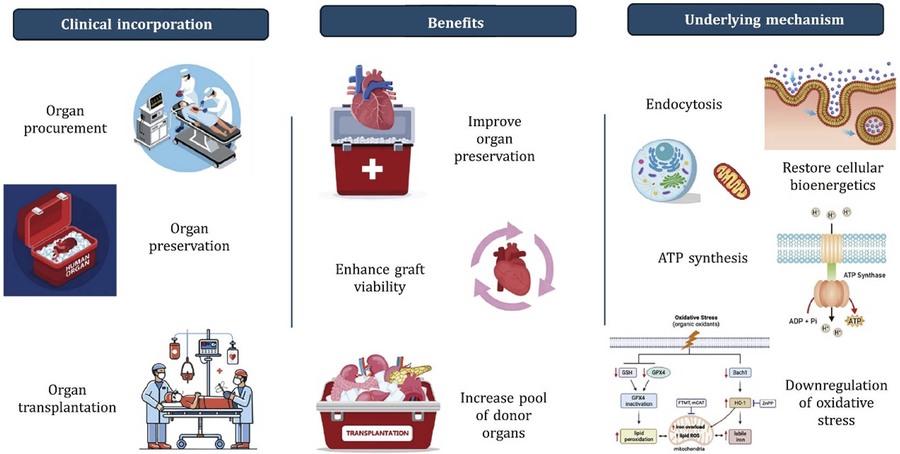
Mechanistically, transplanted mitochondria may enter cells through endocytosis or membrane fusion, replace damaged organelles, restore oxidative phosphorylation, and rebalance redox and inflammatory signaling. Evidence for liver transplantation, however, remains limited to related non-transplant injury models. The proposed clinical framework places this therapy across procurement, preservation, and transplantation rather than at a single step.
The authors said the central idea is to stop treating donor organs as tissues that can only be protected from further decline. Mitochondria could instead give transplant teams a practical way to address energy failure while an organ is already connected to a perfusion system. They said the consistency of benefits across several organs is encouraging, but the field now needs shared standards for mitochondrial quality, source, dose, delivery, and safety. The aim is not to replace preservation, they added, but to transform preservation time into a controlled window for active recovery.
If validated clinically, mitochondrial transplantation could help rescue marginal hearts, lungs, kidneys, and possibly livers that would otherwise be declined, while extending safe preservation windows and making long-distance organ sharing more feasible. It could also be integrated into existing machine-perfusion platforms, allowing treatment and viability testing to occur in the same workflow. Before that can happen, researchers must standardize isolation and characterization methods, determine whether mitochondria from the same individual, another individual, or another species are most suitable, and clarify their long-term fate and immune effects. Large-animal studies and carefully designed human trials will be essential to establish reproducibility, dosing, safety, and whether short-term metabolic recovery translates into durable graft function.
References
DOI
10.1016/j.hbpd.2025.10.003
Original Source URL
https://doi.org/10.1016/j.hbpd.2025.10.003
About Hepatobiliary & Pancreatic Diseases International
Hepatobiliary & Pancreatic Diseases International (HBPD INT) (ISSN 1499-3872 / CN 33-1391/R), owned by the First Affiliated Hospital, Zhejiang University School of Medicine in China, publishes peer-reviewed original papers, reviews and editorials concerned with clinical practice and research in the fields of hepatobiliary and pancreatic diseases.
Chuanlink Innovations, where revolutionary ideas meet their true potential. Our name, rooted in the essence of transmission and connection, reflects our commitment to fostering innovation and facilitating the journey of ideas from inception to realization.
Related Link:
http://chuanlink-innovations.com
—
For the original version of this press release, please visit 24-7PressRelease.com here
Legal Disclaimer: The content on this page is syndicated from independent third-party providers. Kyrion Media makes no warranties or representations regarding the accuracy, completeness, legality, or reliability of the information, including text, images, videos, or licenses. If you are affiliated with this content or have any complaints, copyright concerns, or requests for removal, please contact us at [email protected] with the specific URL of the content in question. We will review and address valid requests promptly.