HONG KONG, July 22, 2026 /24-7PressRelease/ — Streaming has fundamentally changed how people listen to music. With millions of songs available instantly through services like Spotify, owning a personal music collection is no longer considered essential for many listeners.
Yet over the past few years, another trend has quietly emerged.
More users are beginning to rethink how they organize, preserve, and manage the music they care about most. Whether prompted by subscription changes, device compatibility, travel, DJ workflows, or simply a preference for maintaining a personal collection, interest in Spotify Music Converter software continues to grow—not merely as a way to download songs, but as a way to build music libraries that remain accessible over time.
That shift is changing the category itself.
The best Spotify music downloaders are no longer defined solely by how fast they convert a playlist or how many audio formats they support. Increasingly, they are judged by how well they help users organize downloaded music, preserve metadata, manage playlists, and maintain a consistent library across devices.
One product that illustrates this transition particularly well is TuneFab Spotify Music Converter.
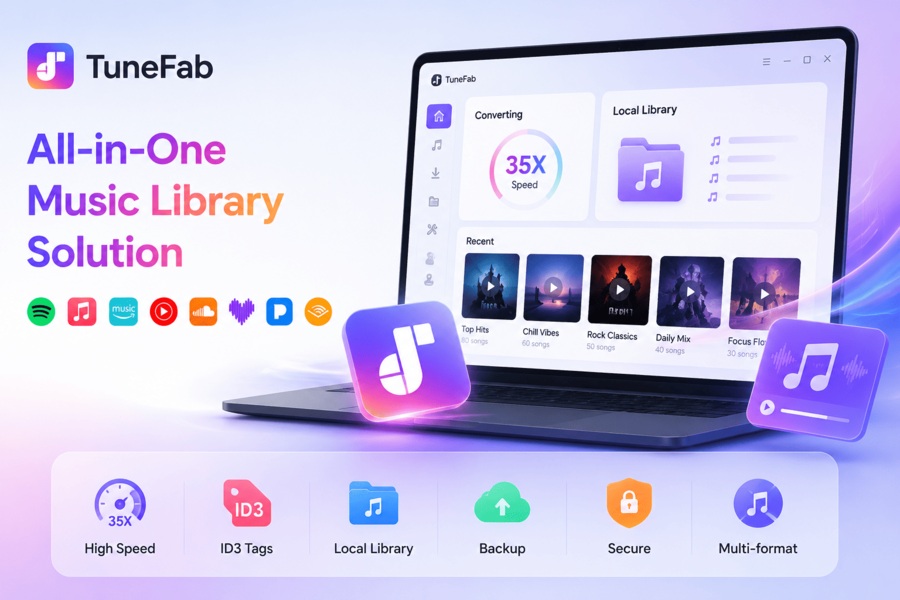
Originally introduced as a desktop application for converting Spotify music into standard local audio formats, TuneFab has expanded significantly in recent years. Alongside music conversion, the software now includes playlist organization, Local Library management, metadata editing, playlist backup, music importing, and additional desktop tools that suggest a broader ambition than simply downloading songs.
That evolution raises an interesting question.
Has the role of Spotify Music Converter software changed from downloading music to managing digital music libraries?
To better understand that question, this review takes a closer look at TuneFab Spotify Music Converter—not simply as a download utility, but as an example of how this software category is evolving.
Why Spotify Music Converters Are Evolving
For years, discussions around Spotify Music Converter software focused almost entirely on conversion speed, supported output formats, and compatibility with Spotify updates.
Those factors remain important today, but they are no longer the only considerations.
Modern users often expect downloaded music to remain searchable, organized, and available across multiple devices. Metadata consistency, playlist structure, cover artwork, folder organization, and long-term accessibility have become just as valuable as conversion itself.
This change mirrors a broader shift in how digital media is consumed.
Streaming platforms excel at helping listeners discover new music, while local collections continue to provide something streaming services cannot fully replace: permanence.
As a result, software developers have gradually begun expanding beyond simple downloading into broader music management workflows.
Instead of exporting audio and leaving users to organize thousands of files manually, newer desktop applications increasingly integrate features that simplify library management after conversion has finished.
Among the products currently available, TuneFab represents one of the clearer examples of this direction.
Rather than positioning itself purely as a Spotify downloader, the software now combines music conversion with Local Library management, playlist organization, metadata preservation, playback, and backup tools within a single desktop environment.
That broader approach makes TuneFab an interesting case study—not necessarily because it introduces an entirely new concept, but because it reflects where the Spotify Music Converter category itself appears to be heading.
A Closer Look at TuneFab Spotify Music Converter
During hands-on evaluation, TuneFab Spotify Music Converter demonstrated a workflow that feels noticeably different from many earlier-generation Spotify downloaders.
Instead of requiring users to move repeatedly between Spotify, file explorers, and separate media managers, much of the process now takes place inside a unified desktop workspace.
The built-in Spotify Web Player simplifies browsing and playlist selection, while Local Library functionality allows downloaded tracks to remain organized after conversion rather than becoming isolated audio files stored across multiple folders.
The software supports exporting Spotify songs, albums, playlists, podcasts, and audiobooks into common formats including MP3, M4A, WAV, FLAC, AIFF, AAC, and ALAC. During testing, available metadata—including artist names, album information, cover artwork, and ID3 tags—remained consistently preserved, reducing the amount of manual organization typically required after downloading larger collections.
Perhaps more importantly, TuneFab no longer feels like software designed solely to move music out of Spotify.
Instead, it increasingly feels designed to help users maintain a personal music library that exists alongside streaming services rather than replacing them.
Performance, Metadata and Everyday Workflow
Hands-on testing suggests that TuneFab’s strengths are less about achieving the highest benchmark numbers and more about maintaining a predictable workflow across different listening scenarios.
Individual tracks completed conversion quickly, while larger albums and playlists remained stable throughout testing. More importantly, playlist structures, available metadata, cover artwork, and file organization remained largely intact after export. For users managing hundreds of tracks, this consistency is arguably more valuable than saving a few extra seconds during conversion.
One of the more noticeable differences from traditional Spotify downloaders is what happens after the download finishes.
Many older tools effectively end the user journey once audio files have been exported, leaving users to manually organize folders, rename files, edit metadata, or import music into separate media players. TuneFab takes a different approach by extending the workflow beyond conversion itself.
Features such as Local Library management, playlist organization, metadata editing, playlist backup, and integrated playback suggest that the software is increasingly being developed as a desktop music management application rather than simply a file conversion utility.
That distinction may appear subtle at first, but it becomes increasingly meaningful as personal music collections grow larger.
The review also identified several practical considerations that prospective users should understand.
Conversion performance naturally varies depending on hardware specifications, network stability, playlist size, and output settings. Likewise, exporting Spotify music as FLAC or WAV should not be interpreted as creating genuinely lossless source audio. These formats preserve the converted output without introducing additional compression, but they cannot recreate information absent from Spotify’s original stream.
These observations are not unique to TuneFab—they apply broadly across the Spotify Music Converter category—but understanding them helps establish realistic expectations before selecting any desktop converter.
Ultimately, the evaluation suggests that workflow reliability, metadata preservation, and library management have become more meaningful indicators of product quality than raw conversion speed alone.
Who Should Consider TuneFab Spotify Music Converter?
Not every Spotify listener needs dedicated desktop conversion software.
For users who stream exclusively within Spotify and rarely move music between devices, Spotify’s own offline listening features will likely remain sufficient.
However, the situation changes for users who prefer maintaining permanent personal collections or regularly work with local audio files.
Music collectors, DJs, educators, frequent travelers, commuters, podcast listeners, audiobook users, and anyone managing large offline libraries may benefit from software designed to organize music after conversion rather than simply downloading it.
From that perspective, TuneFab appears particularly well suited to users who view downloaded music as part of a long-term library instead of a temporary offline cache.
Its expanding feature set reflects a broader understanding that preserving music involves more than saving audio files. Organization, metadata consistency, playlist management, and portability all become increasingly important over time.
This shift also reflects a broader trend across the industry.
As streaming platforms continue to dominate music consumption, desktop music management software is gradually evolving into a complementary tool rather than an alternative to streaming itself.
Final Verdict
The Spotify Music Converter market has matured considerably over the past several years.
Where software was once evaluated primarily by download speed or the number of supported formats, today’s products are increasingly judged by how well they help users manage digital music libraries over the long term.
Within that context, TuneFab Spotify Music Converter stands out not because it attempts to redefine the category overnight, but because it reflects where the category itself appears to be moving.
Its combination of music conversion, Local Library management, playlist organization, metadata preservation, playback, and backup tools creates a workflow that extends well beyond downloading individual tracks.
Rather than positioning itself solely as a Spotify downloader, TuneFab increasingly functions as software for maintaining portable, organized, and searchable music collections that can coexist alongside modern streaming services.
Perhaps that is the most interesting finding from this review.
The future of Spotify Music Converter software may not be defined by who downloads music the fastest.
Instead, it may be defined by who helps users manage their music most effectively after the download is complete.
Viewed from that perspective, TuneFab Spotify Music Converter represents more than a mature desktop converter—it offers a glimpse into how personal music library management is becoming the next stage in the evolution of offline music software.
—
For the original version of this press release, please visit 24-7PressRelease.com here
Legal Disclaimer: The content on this page is syndicated from independent third-party providers. Kyrion Media makes no warranties or representations regarding the accuracy, completeness, legality, or reliability of the information, including text, images, videos, or licenses. If you are affiliated with this content or have any complaints, copyright concerns, or requests for removal, please contact us at [email protected] with the specific URL of the content in question. We will review and address valid requests promptly.